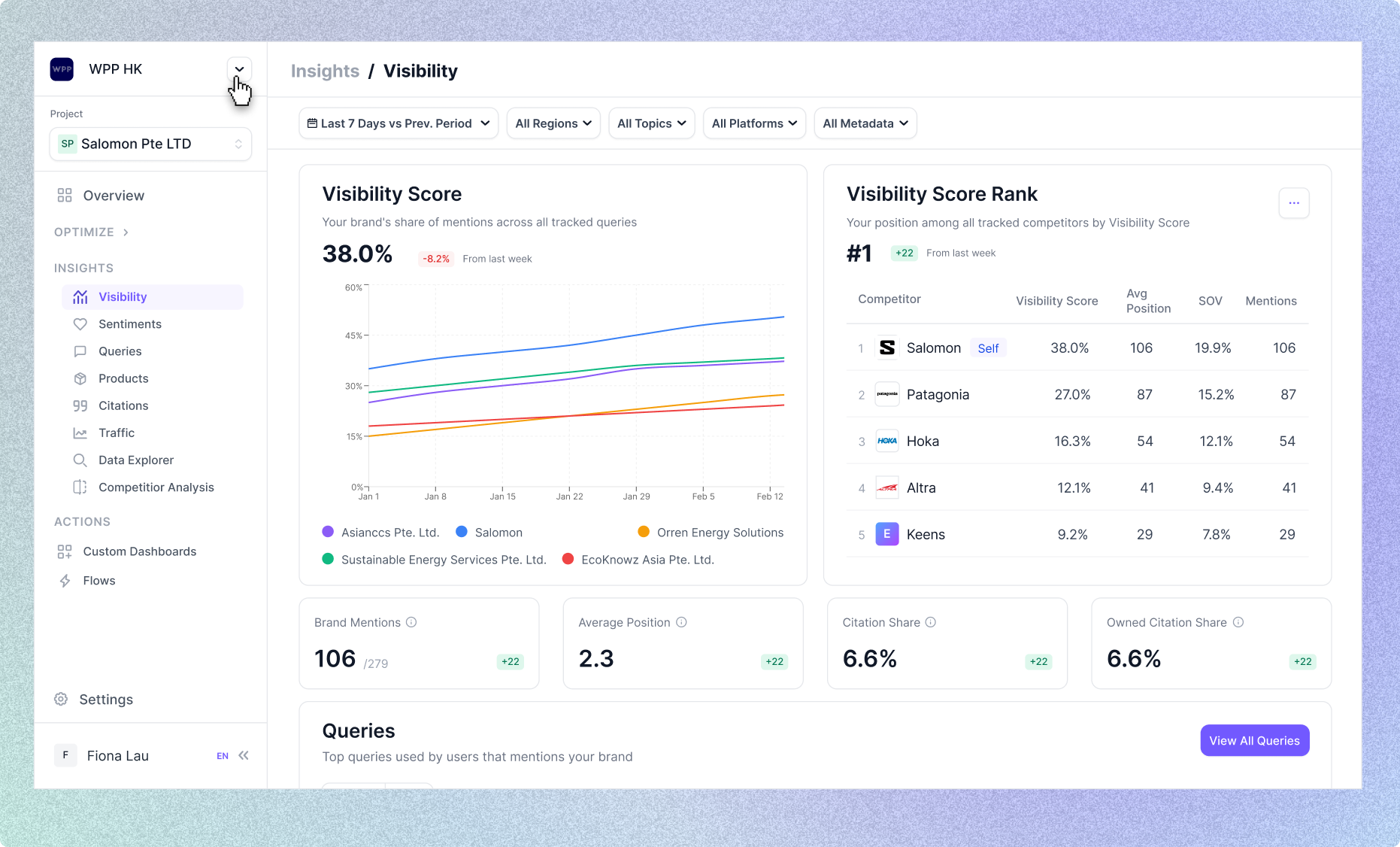
WorkDuo is an Answer Engine Optimization (AEO) platform that tracks how brands appear across LLMs. As part of its growth, the founders were expanding it with a parallel product for Shopify merchants to track their own products.
The founders came with one question — should we merge WorkDuo and ShopDuo, or keep them separate?
Working on a team distributed across San Francisco, Hong Kong, and Singapore with no product managers, this strategic product question fell on my lap and became a unique opportunity: a new domain, a new way of working, and a chance to operate at a product-strategy level, not just design execution.
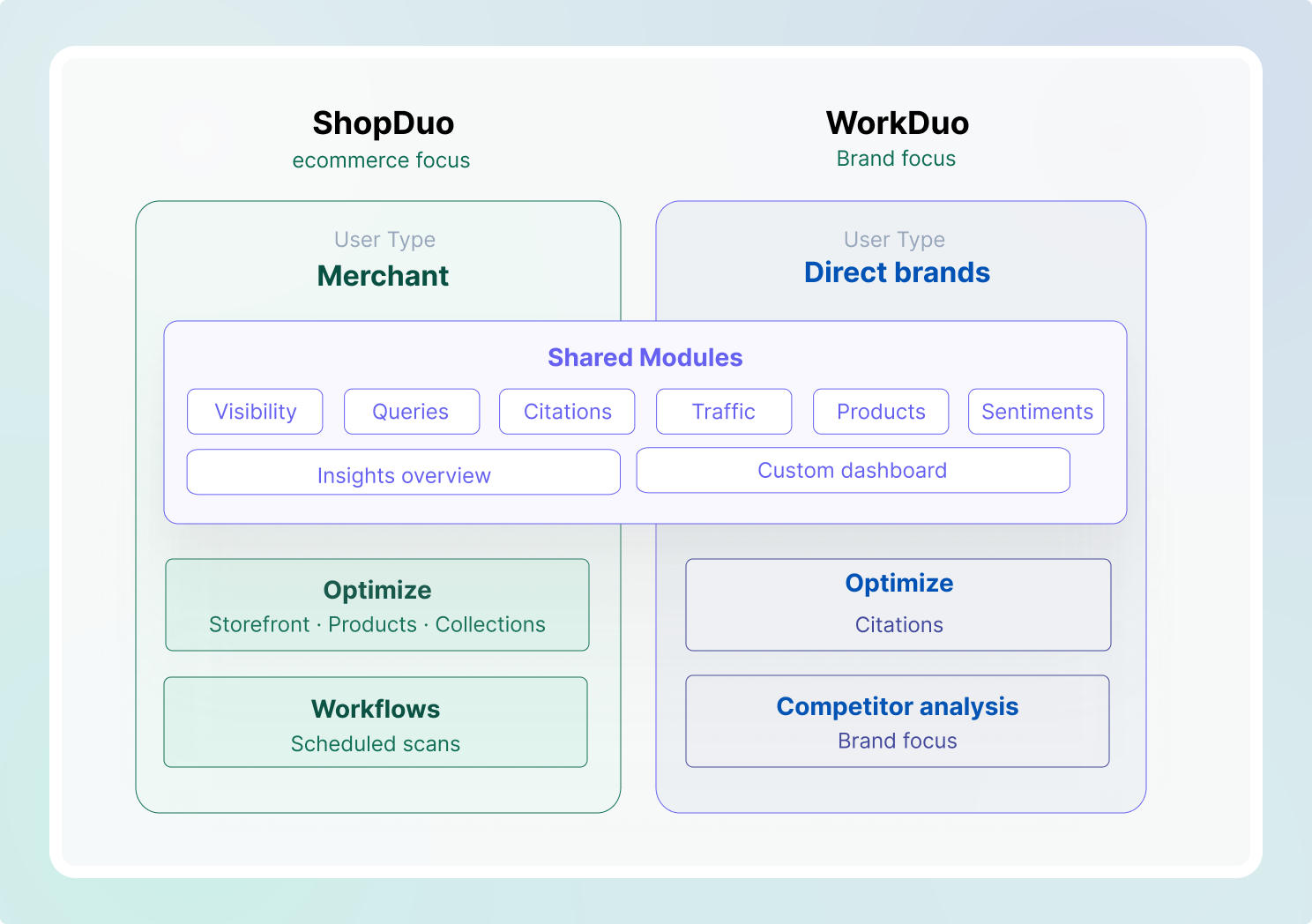
The two products shared an underlying capability — tracking mentions across LLMs. But merchants had an additional layer: they needed to optimize the shop itself, not just monitor appearances. The two overlapped heavily, with a few specific differences that catered to different customers.
In addition to the existing product construct, several conditions made this challenging:
No PM layer. Tony was founder and engineering lead simultaneously. Every product decision had to be made, framed, and sold in the same conversation. I produced the strategy and scope documents myself — not because I was asked to, but because alignment infrastructure didn't exist and someone had to build it.
Two live user bases who couldn't be disrupted. Existing WorkDuo agency users couldn't log in to find their product redesigned around merchants. ShopDuo merchants couldn't be dropped into something that didn't feel built for them.
Unconfirmed scope against a hard launch date. Whether June meant a modular WorkDuo or a standalone ShopDuo build was open when work started. I sequenced decisions so core architecture — nav, onboarding — locked before anything downstream began. A wrong call early would have invalidated weeks of work.
Fully async, voice-first team. Most conversations with Tony happened verbally. I translated them in real-time into written decisions, options docs, and stakeholder frames — creating the written record the team needed to move.
To tackle this binary choice, I dissected the question from a UX perspective:
What would be the better experience for the two distinct groups — merchants and agencies — merge or separate? What would make a cohesive experience?
That reframe unlocked areas of potential friction in the product and shifted the design problem from navigation architecture to product architecture. And it meant the solution had to work on three levels simultaneously:
Why?
WorkDuo becomes a single modular platform. ShopDuo ceases to exist as a brand. One codebase, three account types, modules unlocked at onboarding.
That single architectural decision resolved five downstream questions:
The hardest call within the model: account type is fixed at onboarding. No free switching. That made onboarding extremely high-stakes — misclassifying a user at signup has no easy recovery. I sequenced onboarding as its own workstream, treated with the same urgency as navigation.
Tony validated the architecture. The remaining decisions were commercial and engineering calls, not mine to make.
Strategy layer: A merger strategy document covering the three-account-type model, module-based architecture, information architecture, and open questions. An MVP scope document across four workstreams — Navigation, Onboarding, Overview, Upgrade Path — with done-when criteria, milestone tracker, blocking decisions, and an explicit out-of-scope list.
Execution layer: Three production-fidelity prototypes — Visibility, Citations, Competitor Analysis — built to the WorkDuo design system and usable as direct engineering reference.
The Citations prototype surfaced the Data Explorer as a primary step in the user journey rather than a secondary feature. That was a product reframe that came from design work, not the original brief, and changed how the merchant experience was sequenced.
What went to production: The merged navigation. The remaining workstreams went on hold when funding constraints tightened runway.