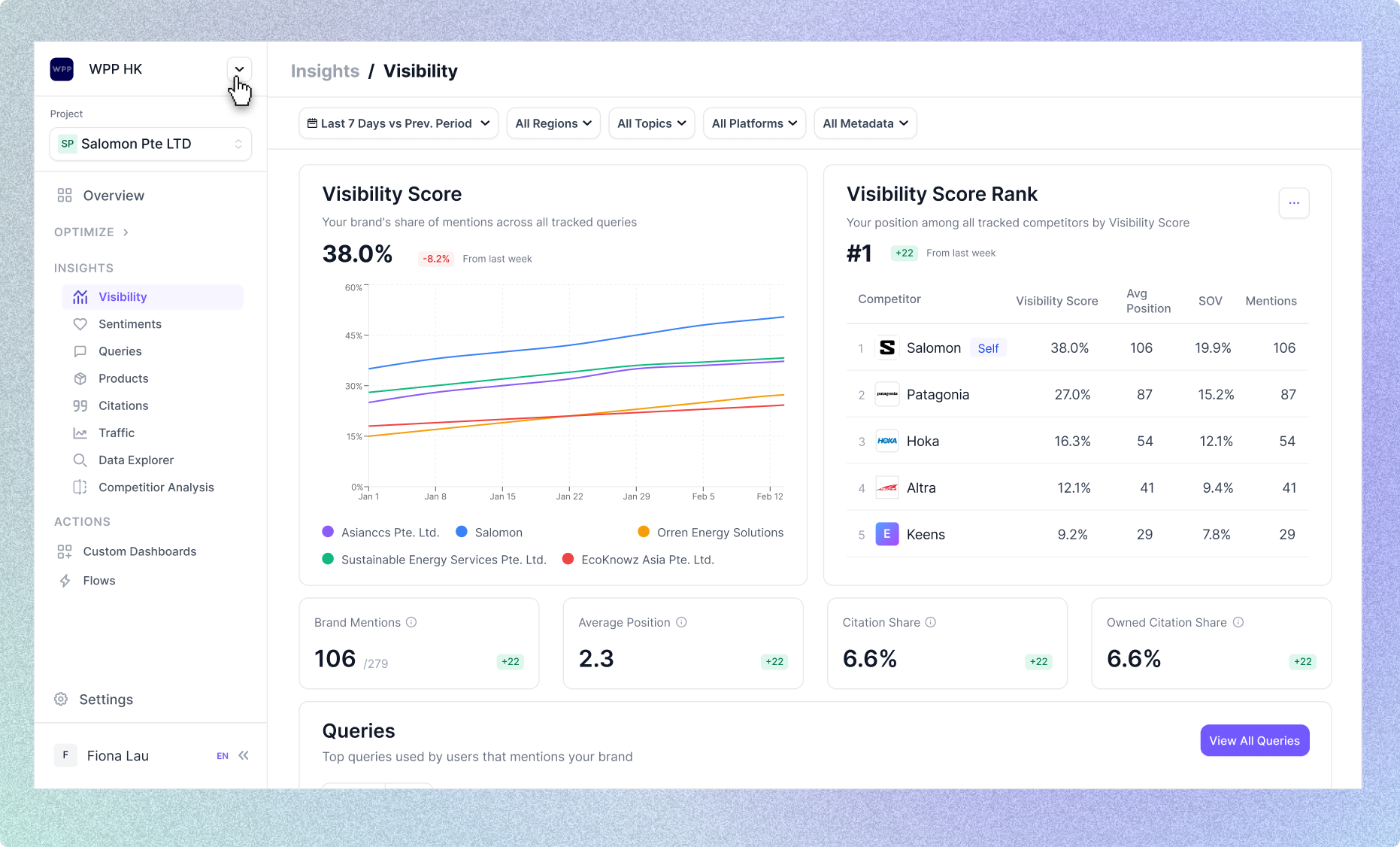
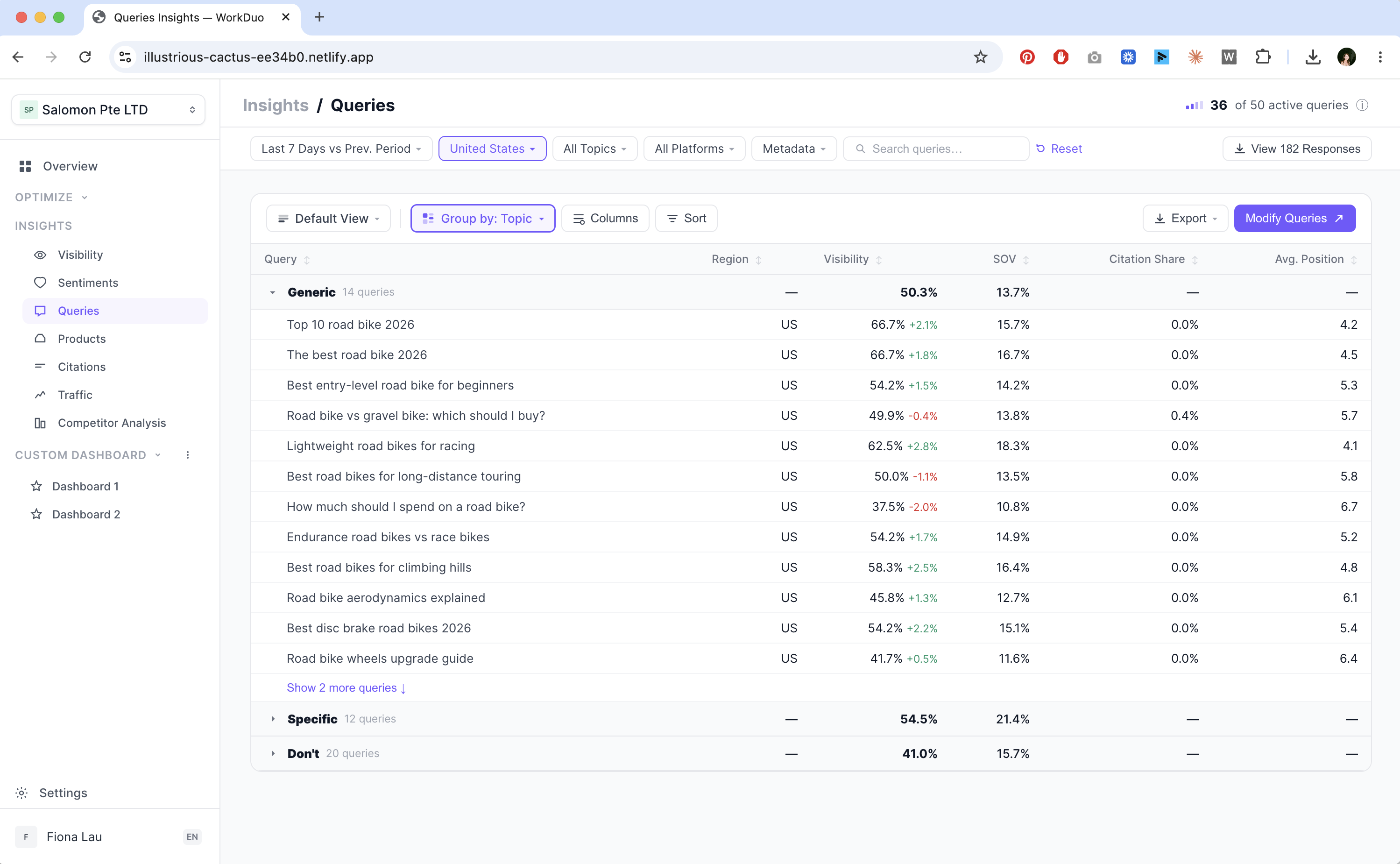
WorkDuo is an AI visibility and brand monitoring tool that tracks how often, and in what context, companies are mentioned by major AI platforms and LLMs. As consumers increasingly turn to tools like ChatGPT to search for and compare products, WorkDuo helps brands understand and optimise how they appear in those results.
The team was building a second product, ShopDuo, aimed at ecommerce merchants tracking their own listings. The founders came to me with one question — should we merge WorkDuo and ShopDuo, or keep them separate?
Working on a team distributed across San Francisco, Hong Kong, and Singapore with no product managers, this strategic product question fell on my lap and became a unique opportunity: a new domain, a new way of working, and a chance to operate beyond design execution and make key decisions at a product-strategy level.
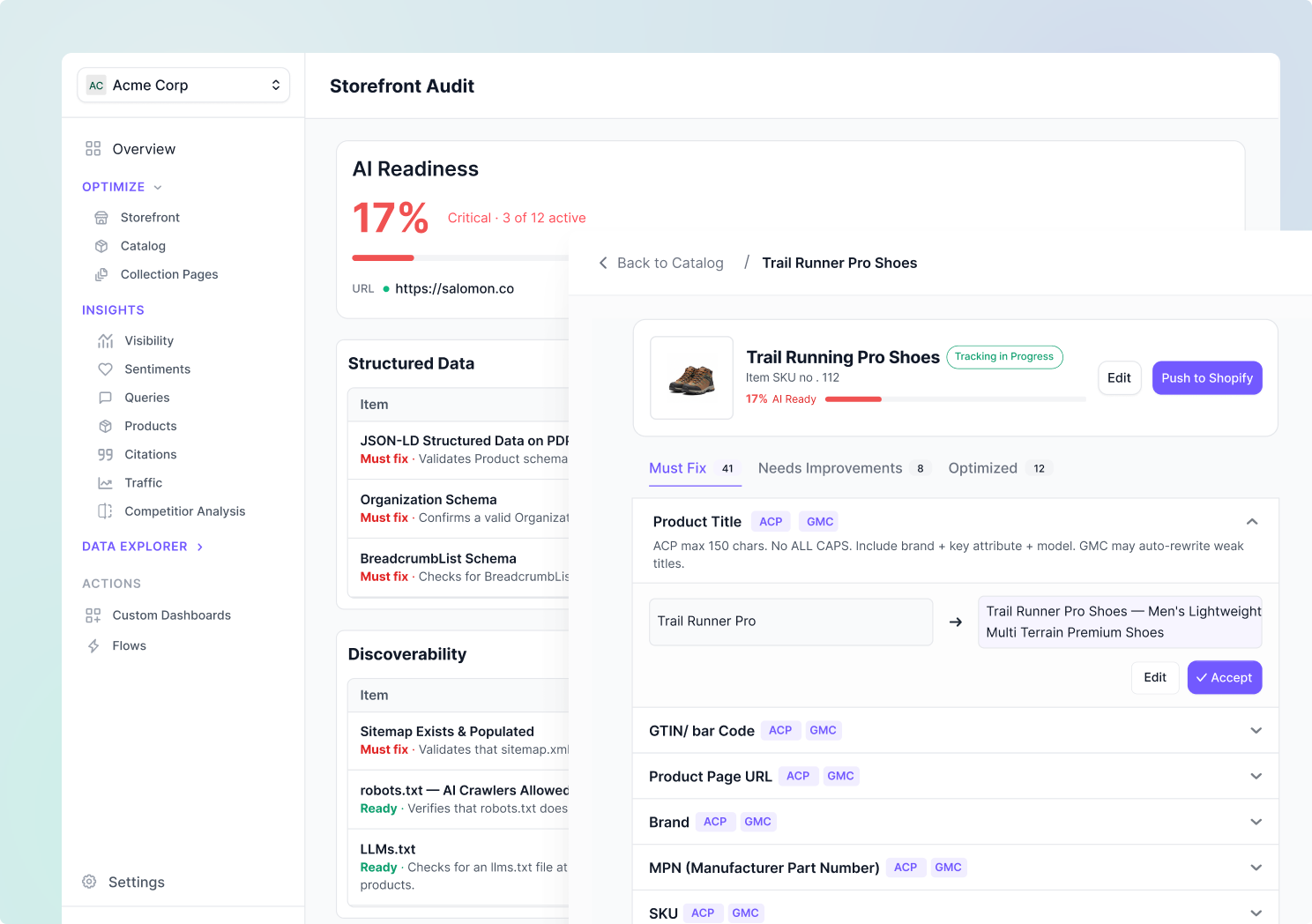
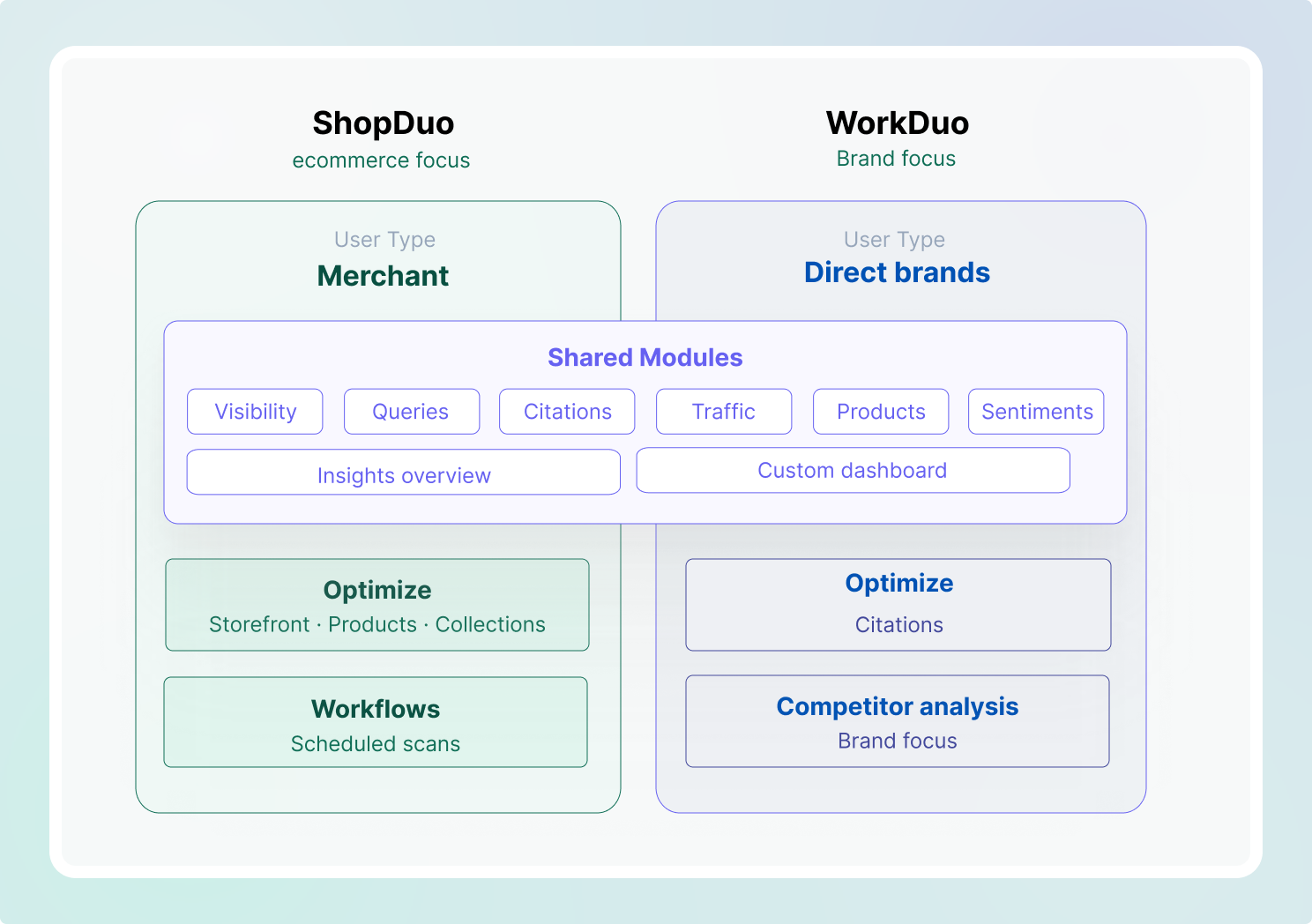
The two products shared the underlying capability of tracking mentions across LLMs, with differing and specific features. Beyond just monitoring appearances, ShopDuo, catering to merchants, had an additional layer of shop and individual product listing optimization. The two overlapped heavily, with a few specific differences that catered to different customers.
In addition to the existing product construct, several conditions made this challenging:
No PM layer. Every product decision had to be made, framed, and sold in the same conversation. I produced the strategy and scope documents myself — not because I was asked to, but because alignment infrastructure didn't exist and someone had to build it.
Fully async, voice-first team. Most conversations with Tony happened verbally. I translated them in real-time into written decisions, options docs, and stakeholder frames — creating the written record the team needed to move.
To tackle this binary choice, I dissected the question from a UX perspective:
Two live user bases had vastly different mental models and used the platform in different ways. Existing WorkDuo agency users couldn't log in to find their product redesigned around merchants. ShopDuo merchants couldn't be dropped into something that didn't feel built for them.
What would be the better experience for the two distinct groups — merchants and agencies — merge or separate? What would make a cohesive experience?
That reframe unlocked areas of potential friction in the product and shifted the design problem from navigation architecture to product architecture. And it meant the solution had to work on three levels simultaneously:
To figure out the magnitude of impact of both approaches, I mapped the full feature set and classified it into tiers. This exercise helped identify the risks and dependencies involved in merging the products.
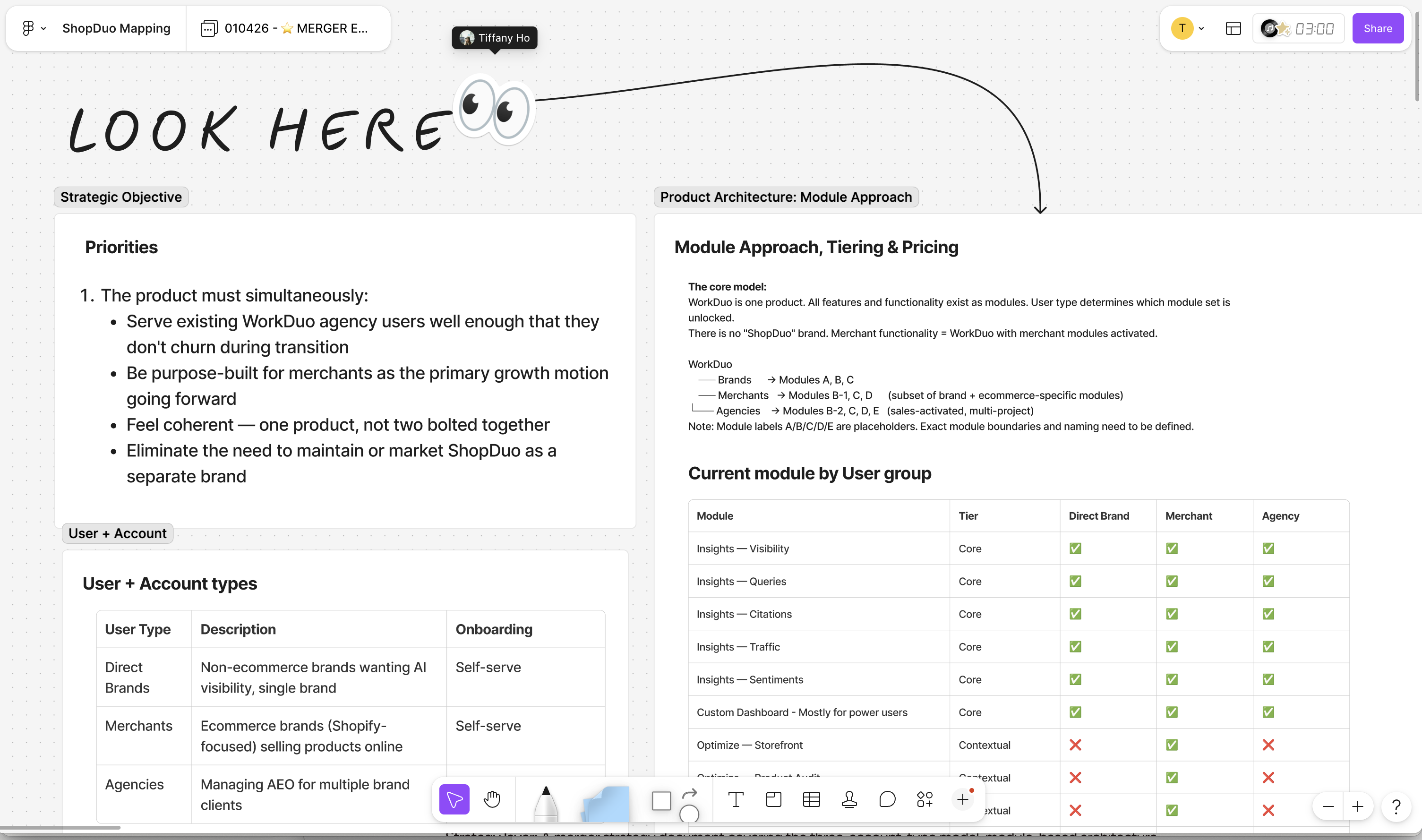
With this clarity, it helped to solidify the final approach:
The core model
WorkDuo is one product. All features — including merchant-specific functionalities — will exist as modules. User type determines which module set is unlocked.
WorkDuo
├── Brands      → Modules A, B, C
├── Merchants   → Modules B-1, C, D      (subset of brand + ecommerce-specific modules)
└── Agencies    → Modules B-2, C, D, E   (sales-activated, multi-project)
This resolved five downstream questions:
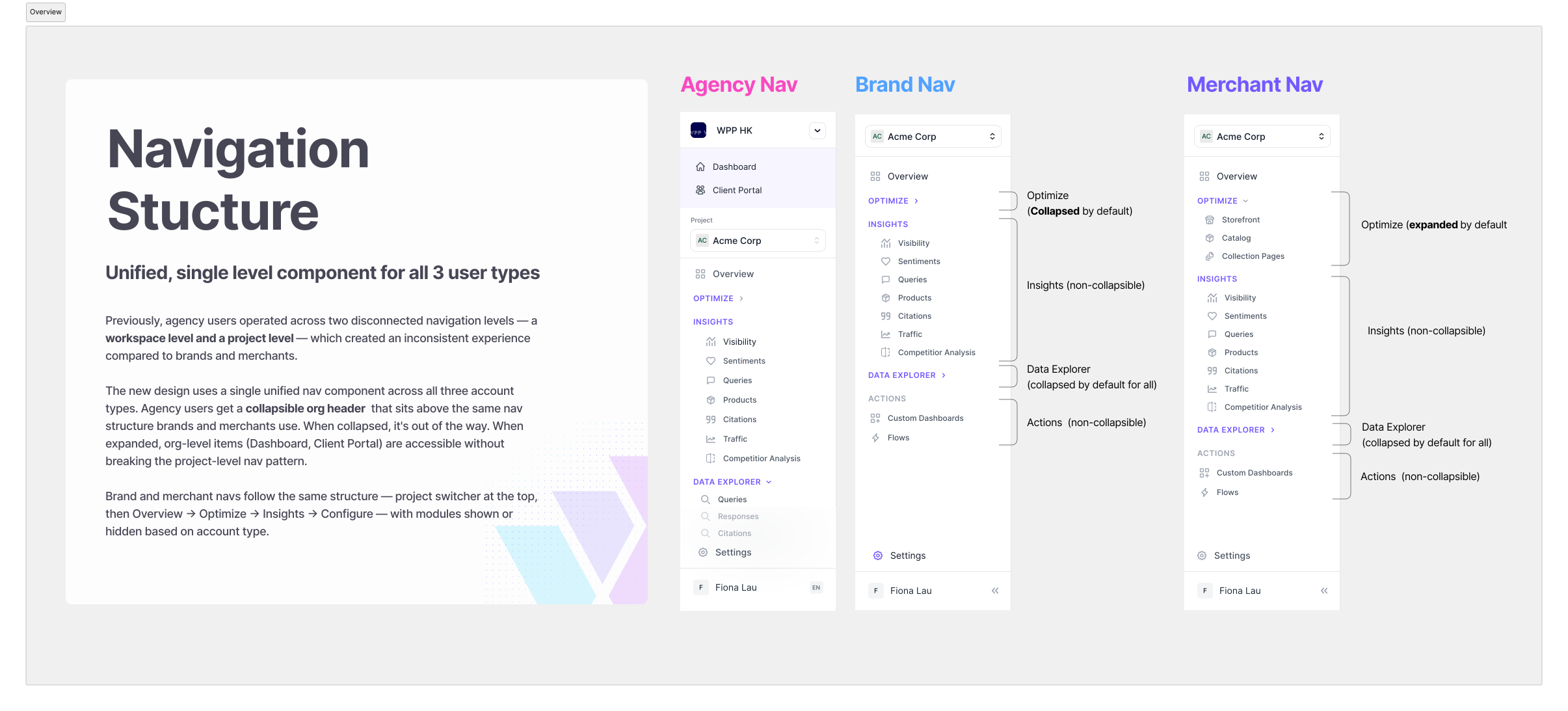
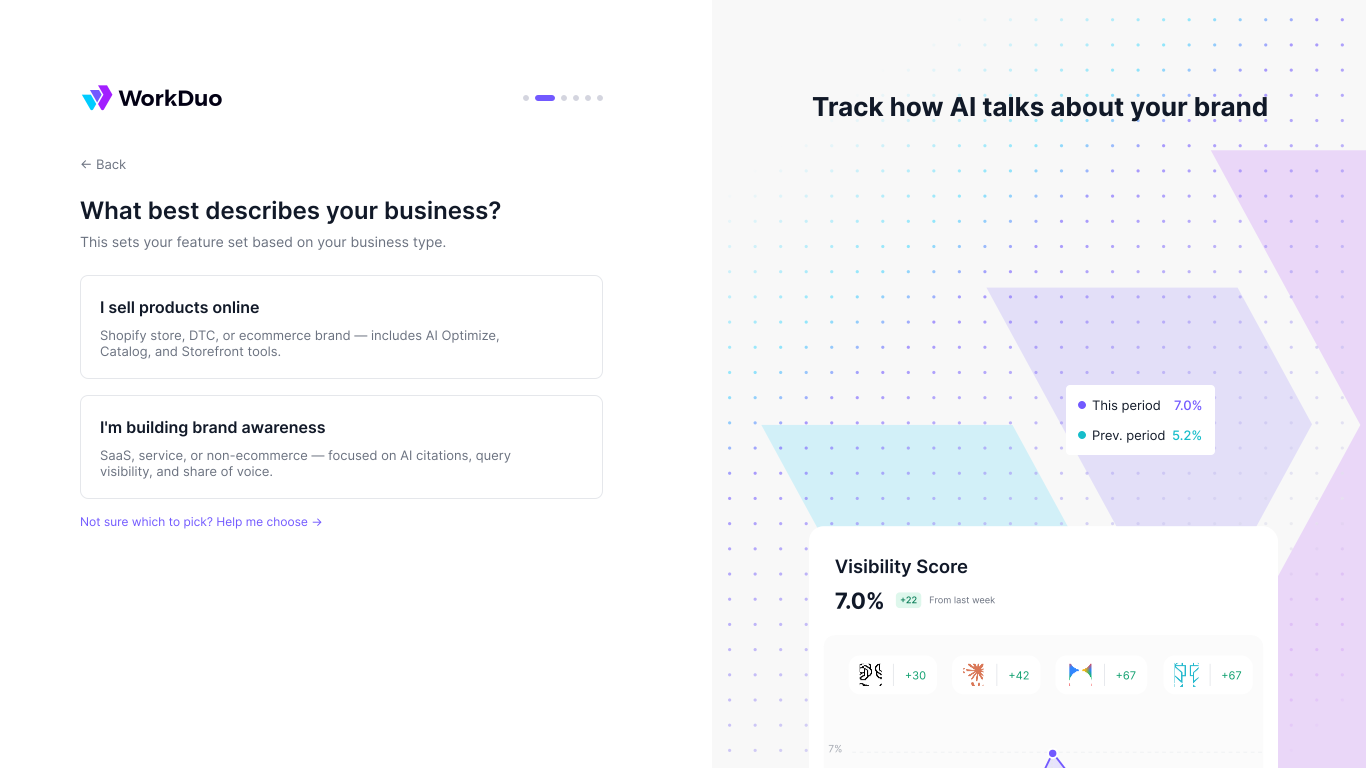
The hardest call within the model: account type is fixed at onboarding. No free switching. That made onboarding extremely high-stakes — misclassifying a user at signup has no easy recovery. I redesigned the onboarding to create a clear fork for the users.
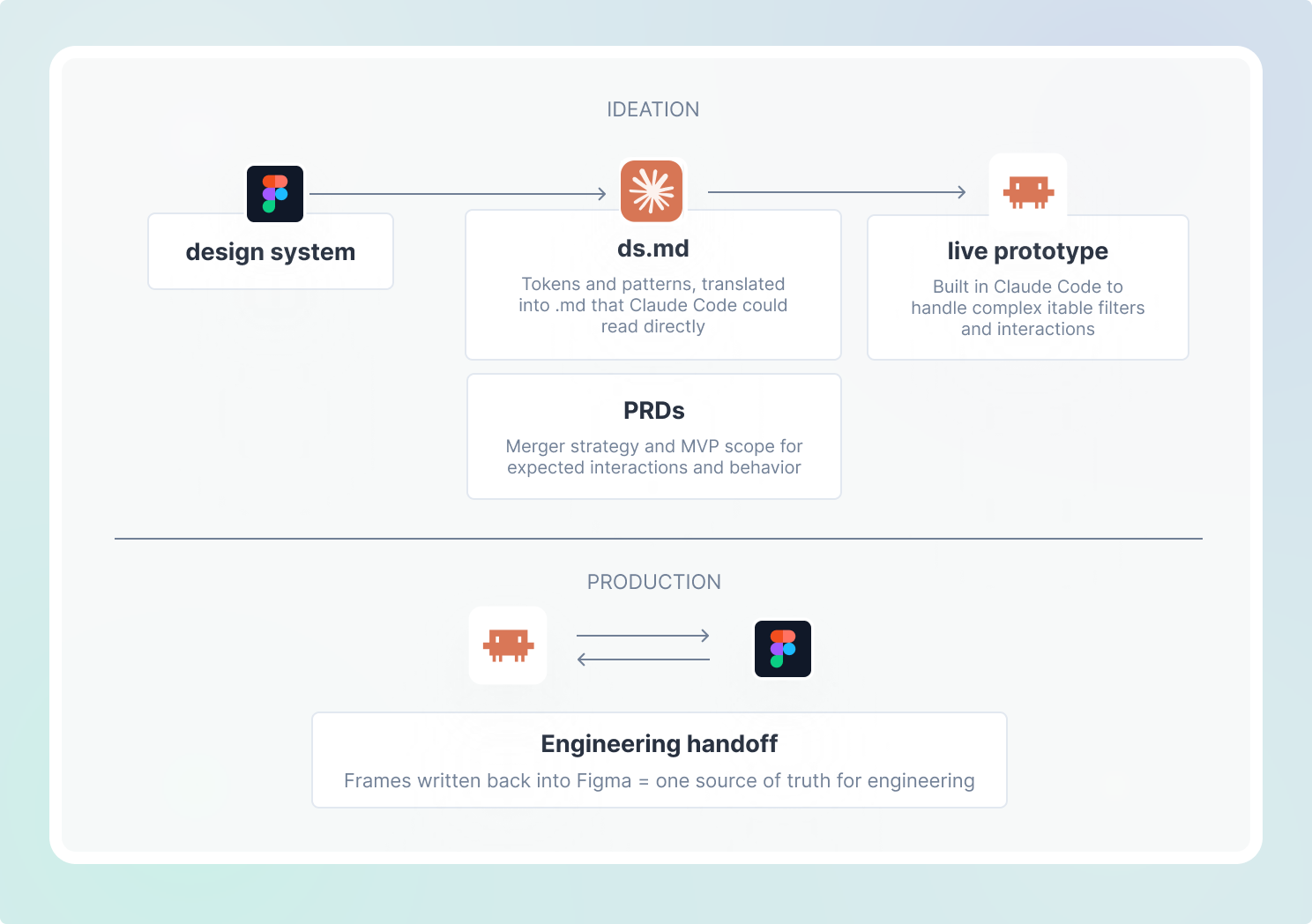
As a solo designer balancing PM duties across different time zones, Claude Code solved one of the biggest pains I have as a designer. (My hands can't move as fast as my brain, and shifting things around to make them pixel-perfect is the bane of my existence!)
Prototypes were built by turning WorkDuo's Figma design system into a written token reference Claude could read. Together with the specs and PRDs already written, Claude Code built the working screens — handling the complex data filtering and sorting the tables needed. Each prototype was hosted on a plain URL, easily accessible to anyone on the team.
The prototypes felt real, worked as intended, and took a fraction of the time hand-crafting screens would have. Across three time zones, that meant no meeting was needed — anyone could click through and see exactly what we meant.
Working in a lean team without a PM gave design a real opportunity: take on a broader scope and tackle product-level problems head on, instead of waiting for someone else to frame them first. The availability of AI tools closed the alignment and communication gaps that distance usually creates, turning specs into clickable prototypes close enough to the real thing that the team could align without another call.
When a broad, ambiguous, strategic question can be crystallized directly into a working prototype, designers get to spend more of their time thinking through the ambiguity itself, treating production as a byproduct of that thinking rather than the main event. That's the work I actually enjoy: sitting inside the ambiguity, not pushing pixels to make it presentable.
Looking back, WorkDuo showed me how much of a designer's scope opens up once the tooling and the environment stop treating strategy as someone else's job.